
QUALIFICATION PROGRAMME
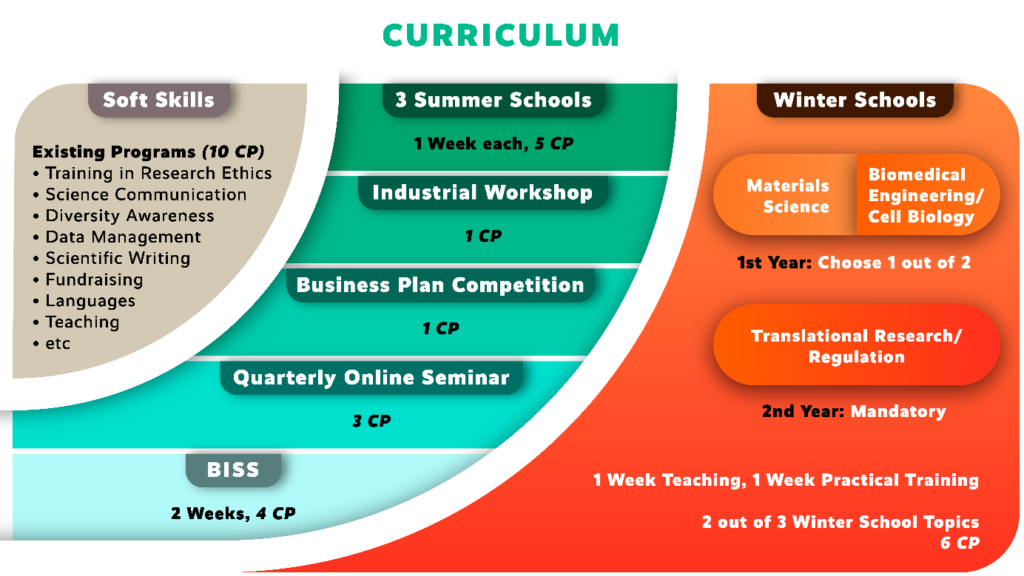
The [MB]² qualification programme is a structured 4-year PhD curriculum designed to develop interdisciplinary expertise across materials science and biomedical engineering, international research experience, and transferable career skills. Each PhD student earns 30 credit points (CP) through a combination of schools, seminars, workshops, and soft-skills training.
KEY FEATURES
- Possible joint doctoral degree from University of Bayreuth and a Melbourne partner university
- 12-month research stay at the partner institution
- Two topical winter schools in Years 1 and 2 (6 CP total)
- Participation in the Bayreuth International Summer School (BISS) on Biofabrication in Year 1 (4 CP)
- Three IRTG summer schools in Years 2–4, including reviewing colloquia and mentoring meetings (5 CP)
- Mandatory industry workshop and business plan competition in Year 3 (2 CP)
- Quarterly online [MB]² seminars with internal and international speakers (3 CP)
- Soft skills programme (research ethics, scientific writing, data management, fundraising, languages, etc.) from existing university programmes (10 CP)
WINTER SCHOOLS
Two topical winter schools are held for each PhD cohort. Each consists of one week of online lectures and one week of practical training.
Year 1 (choose one topic according to background):
- Option A – Materials Science: covering polymer synthesis, biocompatible polymers, protein-based biomaterials, antibacterial materials, nanoparticles, hydrogels, and analytical techniques for soft interfaces
- Option B – Biomedical Engineering / Cell Biology: covering cell and tissue mechanics, surface receptor mechanics, biomimicry, host response to biomaterials, particle–cell interactions, biomarker tracking, and 4D biofabrication
Year 2 (mandatory for all):
- Translational Research & Regulation: training in user needs, design requirements, verification and validation, quality management, risk management, GMP and ISO13485 requirements, with practical training at the ACMD FabHub and site tours at CSIRO, both at Melbourne, Australia
SUMMER SCHOOLS
Year 1: All PhD students attend the Bayreuth International Summer School on Biofabrication (BISS) in person in Bayreuth, Germany (2 weeks, 4 CP). The school covers current trends in biomaterials, biofabrication, polymer engineering, and includes hands-on laboratory training.
Years 2–4: Three IRTG [MB]² summer schools are held in hybrid format. These serve as reviewing colloquia, include mentoring meetings, and feature presentations from internationally renowned invited researchers. Year 3 includes an additional industry workshop (2 days) and business plan competition (3 days), where PhD students work in interdisciplinary teams on innovative biomaterials business concepts.
[MB]² QUARTERLY ONLINE SEMINAR
The [MB]² Seminar is held quarterly online, featuring one internal and one external invited speaker. The seminar series is organised by the PhD Student Committee. External speakers are invited to Bayreuth for extended interaction with the PhD students. Students earn 3 CP over the 4-year programme.
SUPERVISION & MENTORING
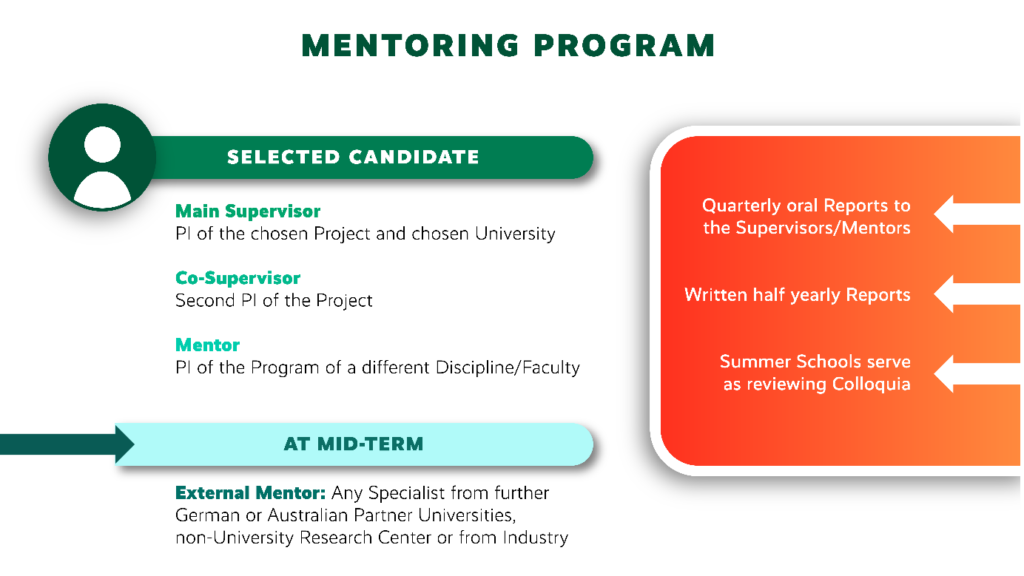
Each PhD student is supervised by a lead supervisor and a co-supervisor from the two countries, supported by two additional mentors. An external mentor (from industry or academia outside [MB]²) joins the team at mid-term (Year 2). Students report quarterly (oral) and half-yearly (written) to their supervisory team. Summer schools serve as reviewing colloquia.
CAREER ADVANCEMENT
Beyond the structured curriculum, [MB]² supports career development through:
- Start-up funding for two outstanding PhD graduates (6-month postdoc support at E13 level) to facilitate transition to postdoctoral or independent researcher positions
- Mandatory exposure to industry via the winter school on translational research, industry workshop, and business plan competition
- International conference attendance (up to 3 per student)
- Supervision of undergraduate and master’s students from Year 2 onwards
- Access to entrepreneurship and innovation training through the Institute for Entrepreneurship & Innovation in Bayreuth
ADMISSION & SELECTION
Applications are invited from graduates holding a master’s degree (or equivalent) in biomedical engineering, biotechnology, chemical engineering, materials engineering, pharmaceutical engineering, or physics.
Exceptional bachelor’s graduates may apply for a qualifying fellowship (9 months) to reach doctoral admission status.
The selection process involves:
(1) a World Café event where Principal Investigators present all projects (upfront registration mandatory – DEADLINE for registration August 28th, 2026);
(2) a written application including motivation letter, short project proposal, and personal video – DEADLINE Sept 25th, 2026;
(3) individual interviews with project Principal Investigators, tbd in October 2026.
Cohort 1 starts in February 2027; applications open now.